Showing posts with label service. Show all posts

Pepperidge Farms and Fame-lust

by Sam Van Eman

Transcript for this recording:

Henri Nouwen once spent seven months in a Trappist monastery in an attempt to escape from his fame-lust; to find, as he put it, "a quiet stream underneath the fluctuating affirmations and rejections of my little world" (The Genesee Diary, 14). While in the monastery, Nouwen worked on their assembly line which produced 15,000 loaves of raisin bread (Monk's Bread) each week.

Consider this journal entry about an observation he made:
"Theodore found a little piece of metal between the thousands of raisins he pushed through the raisin washing machine. He showed it to me. It looked as sharp as a razor blade. Well, someone eating his raisin bread is saved from a bleeding stomach, thanks to Theodore, who will never hear a grateful word for it. That is the drawback of preventative medicine" (112). 
Drawback of preventative medicine? Yikes. This is exactly why someone with fame-lust like Nouwen's needs a time out.

But hold on a minute, Sam. You know precisely what he means. Mixed with even the few generous acts of your own—especially the unrecognized ones—is a hope for praise. You admire Spider-Man for his masked altruism, but you also love the moment when Mary Jane is about to find out who's behind all those good deeds. Don't be too quick to judge.

The Pepperidge Farms magazine advertisement here says, "We're bakers. But we're parents, too. That's why we bake our wholesome bread the way we do. With plump, juicy raisins, sweet swirls of cinnamon—and lots of love." I appreciate the heart at the center of this image. Maybe it's real. I hope, at least, that it's more than a clever graphic, because I'm sure that some of those who made this ad (and this bread) care less about the customer and more about fame.

There are many problems in popular advertising that call for Spider-men and women to address. And there are also many elements that require Theodores to execute selflessly, year after year. Theodores may need to extract the occasional metal shard, but their main focus is on "lots of love," and on the continual production of beneficial goods and services. Not fame.
 
Theodore found more value in making good bread than in heroically avoiding dangerous bread, or in people knowing he made bread at all. It feels impossible for me to be Theodore. Dreams of accolades and promotions too often over-shadow the importance of the work itself, and I find myself needing to remember why it's been given to me in the first place.


Thanks for tuning in. Get the latest posts with an email address:


Read more...

Vocational Surfing: Will Someone Puhleeze Ride that Wave?

by Sam Van Eman

Transcript for this recording:

Hey, it's Friday and you're either glad the work week is over or you're bummed it's coming to an end. My friend and stump-preaching vocation specialist, Byron Borger, refuses to eat at TGI Friday’s for theological reasons. Work was given to us before the fall of humankind, not after. So for that reason, despite the callouses, work is a good thing. And, honestly, because it has service and cultivation at its roots, work brings goodness into the mess that surrounds us. Byron may be onto something.

This morning I came across a surfing video. It's amazing. I've surfed only once but even my three-foot waves made me appreciate water's power and the need I would have for excellence to both understand and work within the ways of that power. In the video scenes where you look into the empty curl, you'll wonder if a surfer will emerge. In the scenes where you watch the surfer under a closing wave, you'll wonder if he will make it.

I didn’t intend to share this in order to create a point, but I couldn't help thinking about the surfing montage and work. TGIF (not the restaurant) is the relief statement of someone who can't seem to emerge. They either lack the vision, or the know-how, or the willingness to ride out what seems like pending doom. And sometimes it is pending doom. Plenty of jobs will eventually reach right over our heads and take us under. But every time?

I would like to see more of us ride this thing beyond Friday.

-----

Enjoy the video below. If you don’t think about work while you watch it, that’s okay. The wave is still amazing.


Thanks for tuning in. Get the latest posts with an email address:


Read more...

Ingredients


Transcript + link to an exercise:
Try thinking about every item you see and every act you do in terms of the raw ingredients that form them. Just as flour and baking soda go into cookies, so do wood and cotton go into chairs, and creativity and ink (and pixels) go into a logo.

Your work – my work – is a combination of a long list of raw ingredients. How we assemble them makes a world of difference. Some recipes produce work that tastes great, but isn’t healthy; other times it’s loaded with nutrition but lacks anything resembling flavor. This presents a challenge. We need to assemble ingredients that end up tasting great and benefiting the consumer. Not always an easy task.

-----

For more thoughts on ingredients and their relation to media consumption, read A Recipe for Film Consumption. You'll find an exercise at the end with a downloadable TV commercial (one of my all-time faves).

Read more...

Angelic Gas

Image by Ruth Hallam
It’s hard to be burdened with your parents’ hell while learning how to make a cow fart. Bobby’s uncle ran a farmette about a mile from our flea market trailer and kept a single cow in the pasture. One summer afternoon while admiring neatly routered crafts in the half-wood shop, half-stall, Bobby called to me.

“Wanna see something cool?”

“Sure,” I said. “What is it?”

“C’mere.” And he turned mischievously for me to follow.

I stepped through the shop door and up onto the rail that contained the heifer. I ran my hand along her back, watching the skin twitch at flies and suddenly forgetting that Bobby had something in mind. Her brown coat felt hot and soft. He was petting along her side, just in front of the pelvic bone, and began to depress the area like a doctor checking for appendicitis. His other hand joined the first and he pressed harder, massaging slowly, front to back, front to back.

And then it happened...a long, loud expulsion of gas from the cow’s behind. To a recent seventh grade graduate, it was possibly the best thing I had ever heard. Bobby had trouble containing himself while pressing again, this time slower now that he had it going, and the beautiful, wonderful sound came forth in a tremendous second wave. They both finally quit. The cow’s wide eye stared at the two of us hanging there in tears.

That’s when the smell hit. Rot and heat mixed to burn our lungs and punish us for teasing. We jumped out of the stall, gagging and laughing hysterically.

I liked Bobby. He parted his hair and said Yes ma’am and swore conservatively like people do who live in the Bible Belt but don’t really go to church. And he was good for me in a way I couldn’t have known then. Beyond the cow and dares to touch the electric fence, bike rides, fort-building and praying we wouldn’t fall to our deaths when his brother whipped rocks at us high in the tree branches, Bobby was helping me escape.

One particular memory confirmed it.

We had constructed a battle scene of figures and machines on his bedroom carpet. I remember the white walls and ceiling fan in his room because these were nicer than what I had in my closet space with the furnace in the corner. We tied fishing line around the body of a WWII fighter plane and to a blade of the ceiling fan. The slow circling threat kept soldiers on their toes. It was a G.I. Joe action-figure set-up like only the kids in TV commercials had.

We pulled the chain to Medium, continuing with our battle language but shifting more attention to the plane. It picked up speed. The painted pilot banked wider and had trouble maintaining control before settling arythmically. Bobby and I glanced at the bedroom door and then at each other.

“What do you think would happen?” he whispered.

I had no other answer. “Let’s find out.”

As soon as I pulled the chain to High and backed away, the plane rose, weaving and dipping wildly. Its left wing caught the ceiling and caused the aircraft to spin desperately out of control. Bobby and I ducked in fear. Neither of us could reach the speed chain before the red fang-mouthed decal on the nose struck the ceiling.

The string broke. The fighter plane shot over us and exploded against the wall above Bobby’s pillow, shattering into plastic pieces of camouflage and outdoing everything those kids on TV had. 

Mischief, I figured then, but it’s therapy to me now because I realize that I had my own commercial going on there; a break from the usual program. Dad had drunk himself reckless, mom was on the run with four of us in a far state, middle school kept me awake at night. Welfare and church people put food on the steps by the scraggly palmetto bush. We all wondered when normal might return.

Here I thought Bobby and I were making cow farts and wrecking his models. We weren’t. He was being normal, with a normal family and normal bedroom walls and a normal life. He was my grace in a battle I couldn’t fight alone; a TV commercial of normalcy in a program of chaos.

And I loved every minute of it.

~ ~ ~ ~ ~
"Angelic Gas" is a response to Marcus Goodyear's call for epiphany stories in the Books & Culture article Only Zombies Worship Styrofoam Jesus.

Read more...

The Work of a Roofer

Jessie Romaneix by permission via Flickr.
For a long time, I refused to work with Pete. He scared me. He didn’t say much beyond his tattoos of naked women and unusual profanities. The story goes that he reacted to a honking driver by exploding out of his car, shirtless and ripped like Bruce Lee, with a baseball bat and wearing his son’s Mickey Mouse Halloween mask. He jumped on the driver’s car hood and screamed the man into repentance.

I knew I had to love Pete. Wasn’t he among the “least of these”? The mean appearance and stories that accompanied his work-release life made a definite first impression. But I had to love him. If I didn’t realize the high calling of roofing as a trade then, at least I knew from the brokenness of my workmates that I had a job to do:
"If you see some brother or sister in need and have the means to do something about it but turn a cold shoulder and do nothing, what happens to God's love? It disappears. And you made it disappear" (1 John 3:17, The Message).
To hear more about my most memorable job (Cold tar tear-offs, for an example), read the rest of this featured article at The High Calling. The High Calling hosts everyday conversations about work, life and God.

Read more...

John Lewis: The Long Wait

In just three days, Adam & Eve's "The Long Wait" had racked up well over a half-million Youtube views. Not bad for a TV advertisement. You'd assume that it was either a freakishly good homemade project recorded and passed along in admiration of a prodigy's A/V talent, or else a heart-string grabber capable of making the average human being tear up. It's the latter, of course. (Being surprised by the True, Good and Beautiful has a way of doing this to me.)

As it goes, "The Long Wait" is simply another in a myriad of consumer-driven, emotion-catching, way-too-early Christmas commercials, this time for the British equivalent of JC Penney, London-based John Lewis. That doesn't seem to matter once the commercial makes its point. It's a well-told story. Little touches like a bouncing knee make it real. And it's honest in the way that you want the protagonist to be your own kid.

Shopping doesn't make good children. Plenty of living rooms will attest to this as they host the worst in our progeny on Christmas morning. But the Good, demonstrated here, reminds me once again that Advent prepares us to hope for the Christ, and for a world that acts like him. Enjoy "The Long Wait."

(Trouble viewing it? Watch it here.)

Read more...

The Immortal Creative

I'm reading The Wounded Healer by Henri Nouwen. I've had it on the shelf for years and somehow neglected to read it, despite it being an unofficial requirement among my colleagues. Page 13 is yellowed with age and littered with "man" in a pre-PC way (so acknowledged in the Introduction), yet the content strikes me as prophetic; ahead of its time. Nouwen was addressing post-modernism in 1972. He recognized then that young people were moving away from absolute truth and, as a result, away from hopefulness.

One particular line caught my attention and I couldn't avoid assigning it to my concern for employees in the advertising world:

"When man is no longer able to look beyond his own death and relate himself to what extends beyond the time and space of his life, he loses his desire to create and the excitement of being human."
Nouwen isn't saying that people can stop creating, even if they lose the desire. And this isn't about the idea of legacy, which can be convoluted in the mind of the insecure (like me) as the ticket to sticking around forever. It's about recognizing that what we do matters. For good or for ill, it matters. Every action I commit results in some change, either in the world at large or in my own household; either in grand, visible forms or in the mind. Every action, they say, has an equal and opposite reaction, like elementary school teachers who alter the worlds of countless children (despite being largely forgotten).

In other words, every 30 second Hulu commercial, TV commercial, YouTube intro, is an act of creation. Even if it's forgotten in five minutes, it is an action that leads to reactions - to sales, to economic shifts, to artistic twists and digital technology, to discontent and Jones jealousy. And when it is created by the hands of employees who have lost desire and don't care about immortality - or about their neighbor for that matter - those reactions wander into whatever voids will accept them.

So I'll keep watching for workers who have an eagerness and hopefulness beyond pay raises, promotions and the bare need to simply make it through another day. I'll keep watching for workers who see their work as ministry in the immortal sense of the word.

Read more...

No touchy.

"No touchy." This phrase from Kuzco, the high-maintenance ruler-turned-llama from Emperor's New Groove, resonates with me. I can't help it. I am a fringe germaphobe, dabbling in the art of knowing where my hands have been.

So when I watch the commercial for Lysol's No-Touch Hand Soap System, I'm intrigued. For a split second, I'm intrigued. And then completely disillusioned:
"You and your family will never have to touch a germy soap pump again."

So? I could see this as a problem if I had to touch the germy pump after washing my hands, but before? Before I wash my germy hands? This product has no logical usefulness. Fear alone will sell it if it sells.

I'm acutely aware of the before/after touching of germy surfaces. For example, it's a major faux pas to place public restroom door handles on the inside of the door yet it happens all of the time. What's the point of washing my hands (No-Touch system or not) if afterward I'm forced to share the exit door handle with so many guys who head out without washing at all? There is no point. It's like touching the soap pump again after my hands have been cleaned. When does this ever make sense?

It seems that bacterial scientists and designers are working on different pages. Talk with each other, people. Good work - the kind Christ followers should see as the standard - gets done when effective profession-level collaboration serves the public in useful ways. And both are needed: the collaboration and the usefulness. Otherwise, I either waste money on senseless products at home or feel tempted in public to knock on the bathroom door, begging someone to let me out.    

Read more...

Not Unless I Have To

I've talked about the Good Samaritan story many times in talks with advertisers and advertising majors because of its comprehensive application. Imagining yourself, in your specific career, playing a specific role in this famous story, can be invigorating. This morning over at TheHighCalling.org, I wrote about it and some of my inadequacies as a servant.

One of my favorite adult-life maxims comes from the end of the parable of the Good Samaritan, where Jesus answers the expert in the law and says, “Go and do likewise.” I know he didn’t (and doesn’t) mean, “Go and become a paramedic,” or, “Go and become an inn keeper so that you can lodge infirmed patients.” He simply meant for me to go and do what must be done for folks whose needs I can meet.

To be fair, I do okay. I take out the neighbor’s trash because his disfigurement requires 20 minutes just to get to the alley. I donate to people. And at every chance given to communicate theology on the importance of work in the here and now Kingdom of God, I give it with conviction.

In other words, I get Go and do likewise. Unfortunately, it's a short list and I’m afraid that most of my going and doing is nice-guy personality - not a result of what Jesus said.  

Read "Not Unless I Have To" here.

TheHighCalling.org is a site full of conversations about work, life, and God.

Read more...

Ethics in Advertising

"If harmful or utterly useless goods are touted to the public, if false assertions are made about goods for sale, if less than admirable human tendencies are exploited, those responsible for such advertising harm society and forfeit their good name and credibility."

- From "Communio et Progressio," a 1960s pastoral letter written by the Pontifical Commission for Social Communications.

"But whatever product, service or candidate you advertise and no matter how you do it, I would hope you would keep in mind our ultimate purpose in life and make of all of your advertising messages that are true, worthy of the dignity of the human person and helpful to the common good." 

- From Archbishop John Foley at the 50th Anniversary of the World Federation of Advertisers.

Read more...

Who Needs You to Go to College?

Image sourced from Microsoft Online.
Most posts here are about advertising, either directly or indirectly. This specific emphasis falls within a larger category of seeing work - all work (sans prostitution and the like which isn't work but some distorted derivative) - as an act of service to others and honor to God. In this broader vein, I want to highlight two items this morning, both containing application points that will hopefully encourage you in the work you do.

Item #1

The first is from Marcus Goodyear, senior editor at the TheHighCalling.org, published poet (you'll see why I mention this) and a thoughtful influencer on the topic of service/honor-based work. His recent blog entry is called Work Isn't Supposed to Be Fun Anyway and here's a teaser:

As a kid I fantasized about traveling to space. Even recently, I was thinking about the Mir space station pictured above. The world needs me in space at the Mir station, I might delude myself. I definitely have a strong desire to go there. I could even imagine that I have talents and gifts that would justify putting me atop one million pounds of rocket fuel and blasting me toward Mir at 29,000 mph.

That’s roughly 28,965 mph over the speed limit in my neighborhood, by the way.

Alas, I do not have a high calling to join the crew of the Mir space station. That is a personal fantasy, not a calling. (Read the rest of his post here.)

Item #2

The second item is by yours truly, and it comes from a growing conviction that we're asking the wrong question about higher education. It isn't logically or practically possible to ask this wrong question, though we do it as consumers and we do it often. So I'm asking a different question, one that is pertinent whether you are in college, going to college or 20 years out. Here is a teaser for Who Needs You to Go to College?:

The Higher Education Research Institute’s Research Brief for the 2010 Freshmen Survey states, “Perhaps most significantly, a large percentage increase (from 66.2% in 2007 to 72.7% in 2010) occurred in students’ views that ‘The chief benefit of college is that it increases one’s earning power.’”

I understand this freshmen view financially. But to what end is it aimed? Work is not separate from community, either in the doing of it or in what it produces. A little creative (and Biblical) analysis will see that education – despite its personal benefits – is ultimately other-centered. (Read the rest of this post here.)

Happy reading.

Read more...

Game Over: It's Time to Live It

Photo by Iris Jones, with permission via Flickr.
I knew my mom should have let me own an Atari. She never budged. I had to do my best mastering Asteroids and Ms. Pac-Man at the bars with dad instead. We were poor, but quarters were one thing I could get in abundance from him when there was no money for anything else. Maybe it was his subversive way of investing in me – helping his boy gain real life skills that might, you know, some day save the world.

Or maybe he was just keeping me happy and out of his hair.

Either way, I have fond memories of those early days gaming. Shooting descending centipedes, saving a girl from a computerized ape, hopping across the road to safety before being flattened by cars and trucks, all while moderately sloshed patrons cheered me on from their nearby stools. Quarter by quarter, I got lost in these virtual worlds despite the clunky, pixilated graphics and limited adventure space of arcade games.

Fast forward 30 years to last week, and I’m now wondering if I should have stuck with those playful quests. If it were up to Jane McGonigal, that’s exactly what would have happened.

To see what McGonigal has in mind, click here to read the rest of this post at the The High Calling.

TheHighCalling.org is a site about work, life and God.

Read more...

A vocational tale of woe and jubilation

Bridge picture from Curious Photos
I began thinking about life direction when a middle school drafting teacher showed appreciation for my drawings. I was an average student but I liked the work well enough that perhaps I heard more praise than was actually there. In high school, I took every architectural and engineering Computer Aided Drafting (CAD) class available. With three or four of those under my belt, and a few miniaturized balsa wood structures glued and tested with satisfying results, I finally decided I would be an architect.

I was a junior and relatively clueless.

During my senior year, I turned down an opportunity to work part-time in a real drafting firm, opting for more CAD classes instead. College quickly approached, and because I really had no idea what being an architect meant, I agreed to try civil engineering (Okay, so the school didn't offer architecture). Besides, I was promised we would make bridges in class - just like in high school! Perhaps this desire to simply extend high school, as well as my refusal to take the drafting firm job, were early yet unrecognized clues that I didn't want to be either an architect or an engineer. I just liked the fun parts.

Discovery in the library

By the second year of college, I knew clearly that I should surrender this now thread of a career dream. Feeling suddenly directionless and pressed for time, I scanned the library shelves for a book on careers. I found a thick volume containing every job known to employees, with accompanying descriptions and average expected pay. In one hour I made my decision. I would become a Spanish teacher.

I told some of the Spanish teacher story in On Earth as It is in Advertising, and I've shared it with many audiences, so suffice it to say that as much as I enjoyed and continue to enjoy the language, I initially chose the profession simply because I liked my 10th-grade Spanish teacher.

That's it.

Superficial reasons for decisions along the way embarrass me to some degree now, though I don't feel alone in this. Having worked with college students for the past 13 years, I see similar patterns over and over again.

Quitting on the kids

I graduated in 1996 with a BS in Spanish Education and entered the public school system for three years. And now I get to my biggest regret to date: I had no idea that faith ought to inform vocation. There I was, a white high school teacher with no white students in perhaps the toughest school in Pittsburgh, and I saw absolutely no connection between a) what the kids really needed and b) vocabulary lists for soccer, beaches and international travel. With no vision (or even awareness that there was vision to be had), I left.

Ironically/Providentially, I landed in the Coalition for Christian Outreach (CCO) where they specialize in helping college students think about faith and vocation. Funny thing is, it took nearly seven years working in the CCO before I thought one bit about this topic as it applies to my former inner city teaching job.

Jubilee epiphany

He was a German teacher from Michigan. It was my seventh Jubilee, a conference on work and faith hosted by the CCO, and for the first time, there was a breakout session for foreign language majors. I decided to attend. The German teacher wasn't riveting, nor particularly ingenious. But after seven years of preaching the importance of faith informing work in chemistry labs, cadaver classes, Work and Faith conferences, articles and countless other venues, here I sat, listening, with rapt attention, to what the Christian faith had to say about teaching foreign language.

I know, I know. Obvious, right? But it wasn't. That afternoon, I began to panic. Regret over missed opportunities flooded my brain. I questioned whether I could continue with the job I loved in the CCO. Visions of burning those out-of-context Spanish textbooks entered my imagination and I saw myself in the old job marching into the Board of Education building, calling for change.

That Jubilee afternoon with the German teacher was the day I really "got it." Everything I had experienced and learned suddenly connected and, though I didn't really have all the answers and still don't, I gained a specific passion that day to help others connect what they do with why they do it; to help students study their faith as much as they study their major; to help employees integrate faith and work in a way that is biblically and theologically sound.

I stuck with the CCO. It took mentors I admire to calm me down and show me that God has timing I cannot trump. There was no way to go back and I had to come to terms with that reality.

I'll be heading back to Jubilee for my 12th year on February 18-20, and while I can't promise that anything miraculous will happen to you if you go, I can assure you that whether you're a student or a seasoned professional, you'll be inspired to renew your vocation.

Read more about Jubilee here, or find an invitation here at The High Calling - a site about life, work and God.   

Read more...

Sons of Martha

I found Rudyard Kipling's "Sons of Martha" last week while reading about the dangers of electricity. I can't quite tell whether the poem is Kipling's jab at Jesus' seemingly unbalanced response to Mary and Martha, or a celebration of work. Either way, it's an interesting take on Luke 10:38-42.

In the story, Mary sits at the Guest's feet to listen while Martha (not unlike a Martha Stewart, I imagine) stays busy with the preparations. Kipling has us realize the true importance of Martha's work. He sides with the laborer. He elevates those who keep the world oiled and moving (read: for the Sons of Mary, those spoiled brats).

Who doesn't feel a little bitterness when team members or office mates or siblings drop the ball and leave us with the weight? Resentment is a common by-product, and this is precisely Martha's problem.

Then she lets it slip. It gets to her enough that she actually tattles to Jesus. Compulsively, she levels the field, and it backfires on her. If only it weren't about fairness and keeping score, Martha and her sons might recognize the special call to work, the risks involved, and the joys it pays out. Maybe then Jesus would say, "Mary and Martha, you have both chosen the good part."

Here's the poem from 1907. See if you can find the electricity reference:

The Sons of Martha

The Sons of Mary seldom bother, for they have inherited that good part;
But the Sons of Martha favour their Mother of the careful soul and troubled heart.
And because she lost her temper once, and because she was rude to the Lord her Guest,
Her Sons must wait upon Mary's Sons, world without end, reprieve, or rest.

It is their care in all the ages to take the buffet and cushion the shock.
It is their care that the gear engages; it is their care that the switches lock.
It is their care that the wheels run truly; it is their care to embark and entrain,
Tally, transport, and deliver duly the Sons of Mary by land and main.

They say to mountains, 'Be ye removed'. They say to the lesser floods, 'Be dry'.
Under their rods are the rocks reproved - they are not afraid of that which is high.
Then do the hill-tops shake to the summit - then is the bed of the deep laid bare,
That the Sons of Mary may overcome it, pleasantly sleeping and unaware.

They finger death at their gloves' end where they piece and repiece the living wires.
He rears against the gates they tend: they feed him hungry behind their fires.
Early at dawn, ere men see clear, they stumble into his terrible stall,
And hale him forth like a haltered steer, and goad and turn him till evenfall.

To these from birth is Belief forbidden; from these till death is Relief afar.
They are concerned with matter hidden - under the earthline their altars are;
The secret fountains to follow up, waters withdrawn to restore to the mouth,
And gather the floods as in a cup, and pour them again at a city drouth.

They do not preach that their God will rouse them a little before the nuts work loose.
They do not teach that His Pity allows them to leave their work when they damn-well choose.
As in the thronged and the lighted ways, so in the dark and the desert they stand.
Wary and watchful all their days that their brethren's days may be long in the land.

Raise ye the stone or cleave the wood to make a path more fair or flat:
Lo, it is black already with blood some Son of Martha spilled for that:
Not as a ladder from earth to Heaven, not as a witness to any creed,
But simple service simply given to his own kind in their common need.

And the Sons of Mary smile and are blessed - they know the angels are on their side.
They know in them is the Grace confessed, and for them are the Mercies multiplied.
They sit at the Feet - they hear the Word - they see how truly the Promise Runs:
They have cast their burden upon the Lord, and - the Lord He lays it on Martha's Sons.

~ Rudyard Kipling

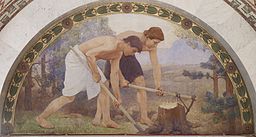
Labor in lunette, by Charles Sprague Pearce. Public Domain.

Read more...

Saving Your Business is Worth $20


Julie's phone went haywire last month. After visiting a local Verizon kiosk, a young employee diagnosed the issue and promised a new purple replacement within one week.

Four weeks later, the package finally arrived.

In this cavern:


And in gray.

Since the original battery, which was purple, needed to be transferred to the new phone, she decided to make a second trip to Verizon. You know what? That same employee offered to mail the cavern on his own and at his expense, ordered the purple replacement to be Fed-Ex'd by today (It arrived this morning, less than 24 hours later), and, to top it off, gave her twenty bucks.

I should clarify: Julie didn't cause a scene or enter the store with mascara-lined cheeks. This kid just recognized a customer in need of frustration diffusion. (Or else he was flirting, in which case I'm sending Julie to Customer Service from now on.)

The amount of money seemed arbitrary to me, but that's what left the biggest impression on her. Sometimes saving your business is worth $20.

Related Verizon posts:
Verizon and World Vision: Marketing Partners
"Is My Map in the Way?"

Read more...

Me Monster

I love Brian Regan's description of the "Me Monster." He nails it for me. And hearing from others, he nails it for them, too.

Advertisers don't get the spotlight very often, but that just means they have to outdo the next guy's creativity, or the next agency's account productivity, or the next manager's public influence, to get their fix. We all want affirmation, but often our quest for attention turns into a trampling exercise driven by insecurities.

I write for High Calling Blogs and last week I shared a story about the Me Monster that you might find encouraging as you deal with your own Me Monster:

David has gone to the same camp for the past nine years. He worked his way up the ranks of awards and badges each summer, impressing counselors and cabin mates. He’s a genuinely good kid and was simply doing what his parents taught him. Last year he received the coveted Teepee pendant, a sure indication that as a camper he had a shot at the granddaddy of them all: the Tomahawk Award.

Only one senior is eligible and he had this final summer to do it... [Read more and watch Brian's video here.]

High Calling Blogs is part of The High Calling, a site about work, life and God.

Read more...

Clear copy. Less clear vision.

Some of you know we bought a house in May. It was a foreclosure and our particular loan process took two full months. We finally closed on July 6 and began a good bit of renovation. I took the first week and half off in order to tackle the bigger items, while friends have been in and out to help. For the past two weeks, I've sanded or cleaned or painted every night, often till midnight.

Sleeping is off. Eating is off. Blogging is way off. As tired as I am, however, I feel energized to push on toward our mid-August goal of moving in. We'll see if that can happen.

Being away from New Breed of Advertisers has had an interesting effect on me. I'm so connected to the house right now that I'm only doing what I have to at work. That isn't my normal operation. Typically, I do what I have to and also try to keep a number of items on the table that I want to do. It's the proactive, creative element of work that sustains me, but I don't have time for it in the present.

Normally, I dream of helping folks do their advertising work well. This summer you all (and other readers) are hardly on my mind. I can't help it. And even though I've watched some TV to help me unwind at night, I haven't seen much that catches my attention anyway. I'm bored by most of the ads, though I'm sure I'll mention a few sooner or later.

In the meantime, here are two bits of copy that I heard, I think, on the radio. They don't get much clearer (and cleverer) than these:

Redwing - "Find the boots that fit your feet, job and wallet." 

Trojan - "You can't wait to get it on."

If you care to, pray for me to finish this house project well, and to find clarity in my service to the advertising industry this year.

My thanks.

Read more...

Verizon and World Vision: Marketing Partners

I had to call Verizon's customer service this morning and saw the following widget in their sidebar:

Not sure why it struck me. I mean, if you're doing good, reputable, work, then companies such as Verizon shouldn't hesitate to partner with you - even if you're a Christian organization - right?

This sort of "witness," or reputation by followers of Jesus, made me think of the recent New York Time Op-Ed article, Learning from the Sin of Sodom.  
 

Read more...

Stouffer's: Let's Fix Dinner

"Can placemats keep your kids off drugs? Could a casserole make your relationship stronger? Can you give your daughter a better body image by setting the table?"


Stouffer's is asking these questions as part of their Let's Fix Dinner campaign, and I like it. I don't know how much of it is a PR stunt to increase sales, but the concern feels genuine to me. Just last night we ate at Grammy and Pappy's house around a pan of Stouffer's Five-Cheese Lasagna, and guess what? It didn't do more for us as a family than hot dogs or spinach salads (Okay, our kids would say it did more for us than spinach salads), but gathering around the table has been essential to our growth, and last night, Stouffer's was what fed our time together.

I like that a food company is playing it's part in strengthening community. I also appreciate the combination of expertise (in this case, professional food making) and calling (to build healthier families), which inspires similar combinations in my own work.  

Visit Let's Fix Dinner. Tell them thanks. Take their test. If you take it, come back and tell us how you fared. Or just tell us if you think they're on to something.  

Related post:
Hyundai Assurance

Read more...

Hyundai Assurance

Hyundai's approach has that Public Service Announcement feel and (though it could be the guy's voice) it strikes me as honorable.  


"...because the economy hasn't really turned around for any of us, until it turns around for all of us."

This line does make me Think About It - not as a car purchaser at this time, but as a neighbor to Hyundai. I asked Greg Stielstra about the fine line between serving and being served. He wrote Faith-Based Marketing: The Guide to Reaching 140 Million Christian Customers after marketing Rick Warren's Purpose-Driven Life to international fame. The interview gets a little spicy in part 2, but I appreciated his insight which you can read here.

Read more...

  © Free Blogger Templates Blogger Theme II by Ourblogtemplates.com 2008

Back to TOP